On the Fragility of Tasks under Composition: Implicit Budgeting in Language Models


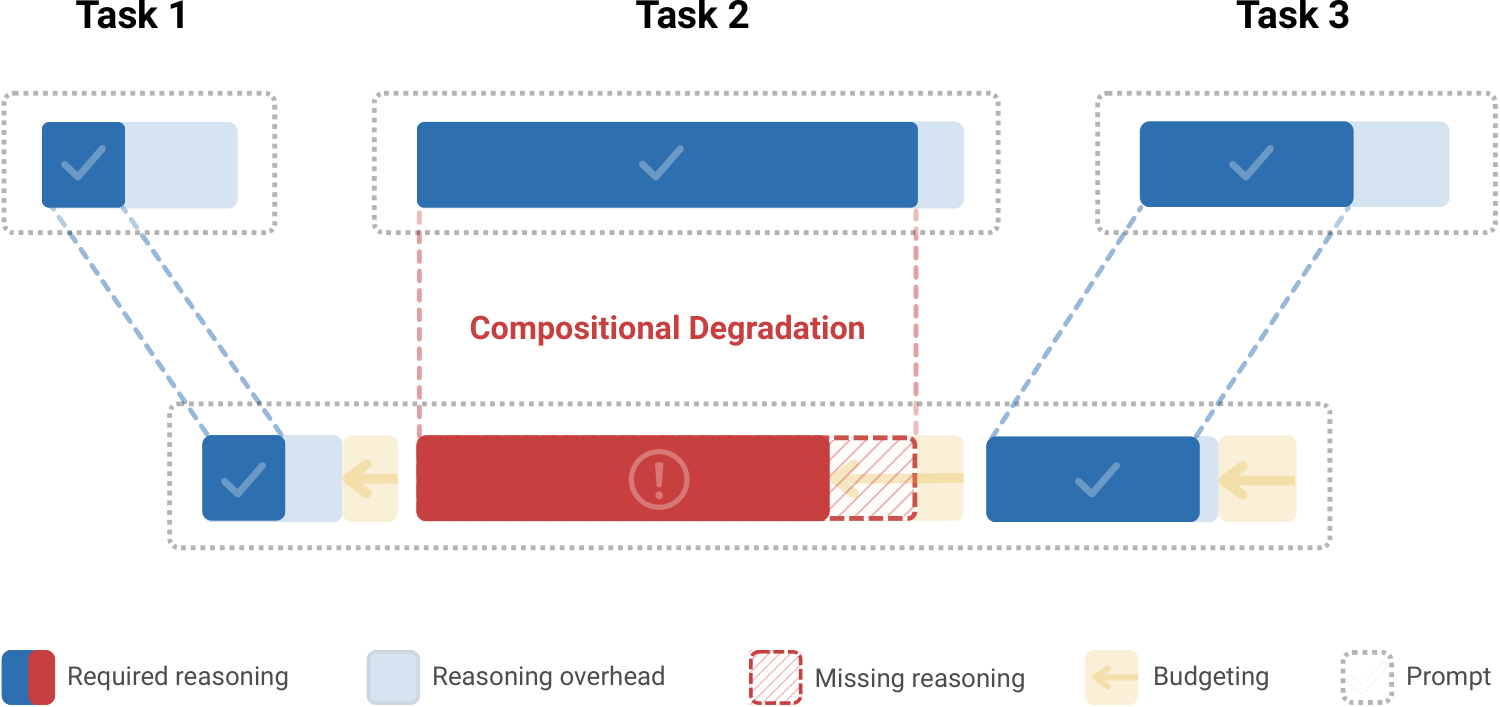
TL;DR: When prompts are composed of many tasks, language models systematically reduce their reasoning effort across tasks according to a power law, causing failures on those that require more effort. By adjusting task grouping based on task fragility, we can save 43% of tokens without degrading accuracy.
1What is compositional degradation?
Modern language models are increasingly asked to handle several tasks at once, such as answering a set of math problems or following a list of instructions before answering. However, common benchmarks still test one task at a time, which might overstate how robust these underlying abilities are. We ask whether a model that reliably solves a task on its own can still solve it when other tasks share the prompt.
A composition is built from several independent constituent tasks, which are composed into one prompt and answered in order. First, we filter tasks a model solves in 3 out of 3 isolated attempts, then build composed prompts of these constituent tasks. Strikingly, even for these reliably solved tasks, compositional degradation shows up for all tested models across math and language datasets.1
Empirical evidence: accuracy drop vs composition size
1.4 instead of 1. 4), and such answers count as wrong.If a model can solve every constituent task alone, why does it fail a composition of them, and what mechanism drives it?
In recent years, LLMs have gained immense abilities through stepwise thinking, which heavily influences task success. Hence, a composition of tasks might alter how a model thinks about each problem in detail, leading to degraded abilities. We argue that this is the case and propose the following hypothesis:
Compositional degradation arises from a misallocation of the implicit thinking budget, where, under composition, LLMs systematically reduce thinking, thereby especially underallocating reasoning in high-effort tasks, causing degradation in those.
2How does thinking change under composition?
To observe how thinking tokens are distributed under composition, every task in . The model names the tag whenever it turns to a task, which allows for an exact attribution of thinking tokens. The token ratio r = T(k) / T(1) is a measurement of how much of the thinking tokens in isolation remains when the task is placed together in a composition of k tasks.
Ten random compositions per k, one per seed, all sharing a marked task; all other tasks are random. A segment starts wherever the model names a tag. The grey task is the dummy, which is left out since its token estimation is unreliable.
Measured across many open-weight LLMs, the token ratio reduces as a power law, r ≈ km, with median slope m = −0.54 and median R² of 0.91. For instance, with 4 tasks each keeps about half its thinking; with 10, about 29%.
Under composition, LLMs reduce thinking tokens for each task, by applying roughly the same proportional reduction (with factor km) to all of them.2
3What tasks fail under composition?
This reduction in thinking causes highly uneven degradation of task solving abilities. Fragile tasks, the ones with long thinking traces in isolation, lose the most accuracy, whereas tasks that are robust to this reduction we call non-fragile, since they show almost no degradation.3,4
When solving tasks in isolation, LLMs typically allocate a sufficient thinking budget to each. Under composition, however, they systematically underallocate this budget, and tasks they reliably solve in isolation, fragile ones in particular, start failing.
Empirical evidence: accuracy drop vs token reduction
4Exploiting implicit budgeting for efficient inference
Fragility-aware batching. The composition size k controls how much thinking is spent on each task. We propose a strategy that assigns non-fragile tasks large compositions to save tokens, and keeps fragile tasks in small ones to avoid degradation.
The result is 43% fewer tokens on average across datasets, with accuracy mostly preserved. Random batching saves more tokens, but it often comes with a substantial accuracy loss. The method is black-box, needing no weights or internal states, so it also works on Claude Opus 5: 24% fewer tokens on GPQA-Diamond while losing less than random batching. For unseen tasks, a linear probe on task embeddings predicts fragility and still saves 31% of tokens while losing at most 0.5 pp.
Full results: all models and datasets
Limitations. Fragility-aware batching is most effective on datasets with a mix of fragile and non-fragile tasks. At either extreme, naive strategies work equally well. On the one hand, OneWordQA and StrategyQA require only little reasoning, so almost all tasks are non-fragile, thus random grouping works equally well. On the other hand, tasks from AIME cannot be composed since it always leads to a substantial accuracy degradation, thus isolated solving is best here.
Also, due to limited training data availability, the linear probe currently does not generalize across different datasets, limiting its use in production. However, an interesting path for future work would be to scale such fragility predictors with more diverse data.
5Discussion & Implications
We have shown that the misallocation of the implicit thinking budget can act two ways, like a double-edged sword. On the one hand, it causes degradation under composition and reasoning overspending in isolation. On the other hand, this misallocation can be manipulated to save tokens without impacting accuracy. Since LLMs are already heavily used in production, what do our results imply?
Long-running agents in production. Compositional degradation is particularly relevant to agentic workflows, where tool outputs, interaction histories, and intermediate results continually accumulate. Agents are widely observed to degrade as their context grows, a phenomenon known as context rot. Our results point to a degradation that sets in long before the context fills up: a high-effort step can be unknowingly misbudgeted, possibly leading to error propagation in subsequent tasks. As a direct practical intervention, agents can keep their context lean and hand reasoning-intensive steps to subagents that start from a fresh context.
Post-training as a potential mitigation. Our results suggest that reasoning allocation contributes to the difficulty of composed tasks, even when the constituent tasks are solvable in isolation. Integrating budget management into RL pipelines through explicit training on composed tasks could help models allocate reasoning more effectively across a shared prompt.
Citation
@inproceedings{li2026fragility,
title = {On the Fragility of Tasks under Composition: Implicit Budgeting in Language Models},
author = {Li, Chenpan and Brockmoeller, Thies and Jegelka, Stefanie and Gupta, Sharut and Karalias, Nikolaos},
year = {2026},
}* Correspondence: chenpan.li@tum.de ◇ Equal advisory role.
Page design inspired by Base Models Can Reason By Taking a Cue From Training Data and The Platonic Representation Hypothesis.